

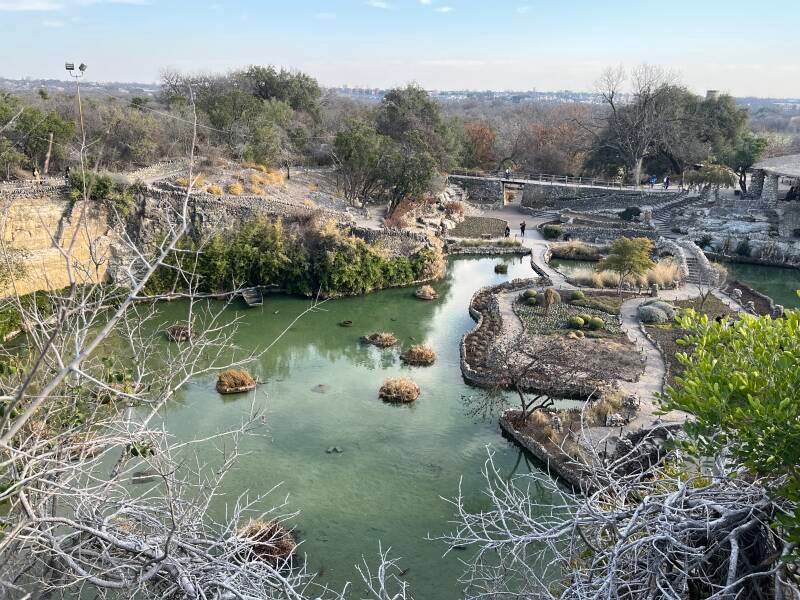
When one plan didn't work out, I found myself at the Japanese Tea Gardens. Completely losing track of time, I spent well over five hours there. Walking the path, watching the Koi in the crystal-clear water, the Koi fry stirring up the sand beneath the water. The pathways covered in stone and pebbles of all shapes and sizes. The different flowers blooming vibrant, radiant colors. Watching the water just fall down the cliff side and listen to it as it crashes into the pond below. I even found my way to the top, able to look out and see the whole garden all from one view. I even managed to find a semi hidden trail that led me right to the top of the waterfall, and to a small cliff where I could just sit and take in the beauty. The sights and the sounds were just so breathtaking and peaceful, and it was rather easy to spend so much time there.




Timeline history of the Japanese Tea Garden:
1840: German masons quarry limestone blocks for for the construction industry.
1852: The City begins leasing the quarry site for commercial use.
1880: Alamo Roman and Portland Cement Company constructs the first cement plant west of the Mississippi River.
1889: The tall stack Schoefer-type kiln was built. It is a landmark in the gardens today.
1899: George Washington Brackenridge donates 199 acres along the San Antonio River near the quarry to the City for use as parkland. He will continue to donate land to the park.
1901: Brackenridge Park opens to the public.
1908: Alamo Cement abandons the quarry site on Rock Quarry Road (now Saint Mary’s Street).
1915: Ray Lambert is appointed as City Parks Commissioner and begins to further the development of Brackenridge Park
1917: Under the direction of Ray Lambert, Park Engineer W. S. Delery develops plans for a “sunken garden”.
1918: Construction begins with the assistance of City staff and prison labor.
1919: Construction of bridges, island, ponds and pavilion is completed. Landscape is installed.
1919: Lambert invites Japanese-American Kimi Eizo Jingu and his family to live in a house in the gardens. Jingu was an artist specializing in Japanese style painting. Rae Jingu, the first of their children to be born in the gardens arrives in August. She is named after Commissioner Ray Lambert.
1920: A small “Mexican Village” was reconstructed featuring Mexican artisans and craftsmen as well as an outdoor restaurant.
1925: Daughter Mabel Jingu is born in the gardens.
1926: Jingu opens the “Bamboo Room”, serving light food and tea. Iced green tea and green tea ice cream are born. He becomes a representative of Shizuoka Tea Association.
1938: Kimi Eizo Jingu dies, leaving his wife and seven children to live and operate the gardens.
1941: Jungu family evicted due to anti-Japanese sentiment of World War II. The gardens are renamed “Chinese Tea Gardens” and Chinese-Americans Ted and Ester Wu open a snack bar.
1942: A sculpture called the “Chinese Tori Gate” was constructed by artist Dionicio Rodriguez at the entry to the gardens.
1943: Jimmy Jingu enlists in the US Army. He receives injuries in Italy for which he received the Purple Heart.
1976: Added to the National Register of Historic Places ( listed as Alamo Portland and Roman Cement Works).
1984: The gardens are officially renamed as the “Japanese Tea Gardens”
1984: The gardens are named as a Texas Civil Engineering Landmark and Registered Texas Historic Landmark.
2006: The Pavilion is renovated with the assistance of bond monies and San Antonio Parks Foundation.
2008: The lily ponds are improved and sealed. The ponds are filled and the fish and plants are restored. A plan to renovate the Jingu home is completed.
2009: Funds are raised and restoration begins on the Jingu house. Completion is expected for the Spring of 2011.
2011: The remodeled Jingu House will have its public opening on October 22, 2011.
2015: A new “Japanese style” design was created by Japanese gardener, Don Pylant, and architect Kim Wolf (RVK & Associates) to give the garden a more Japanese feel, while keeping the element of seasonal color and subtropic aesthetic of San Antonio. The landscape was partially installed during 2016.
*timeline and more information and history found on the history | Japanese Tea Garden (japaneseteagardensa.org)
Add comment
Comments